The Network Society Paradigm & Liquid Life

WHAT IS THE NETWORK SOCIETY PARADIGM?

Firstly, I would like to introduce this blog post by breaking down what this module was focusing on before diving deeper into its aspects and the main focal example I will be using: Liquid Life. 

The idea of the network society paradigm is simply – “a society whose social structure is made up of networks powered by micro-electronics-based information and communications technologies.” Theorist of the concept, Manuel Castells (2004 p. 3). 

Communication was never always as electronic based as it is today. In fact, it was always at a distance in and not at all ‘constant’ until the 19th Century. Around this time came the invention of the telegraph (1837), and from this moment communication became ever so changing. Now, this is where the idea of the network society comes into play. “…absolutely annihilating space and running in advance of time…a net-work of nerves of iron wire…” (The New York Tribune, 1845). 

THE NETWORKS

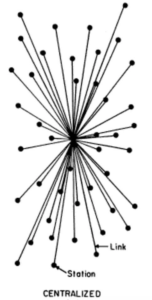
Centralized – the idea of a centralized network is it being owned/run by one company/community. This allows for that one authority figure to gain control over content, servers, or source codes. This is the type of network which aligns with most contemporary applications around today. “Data resides on a centrally owned database controlled by a company.”

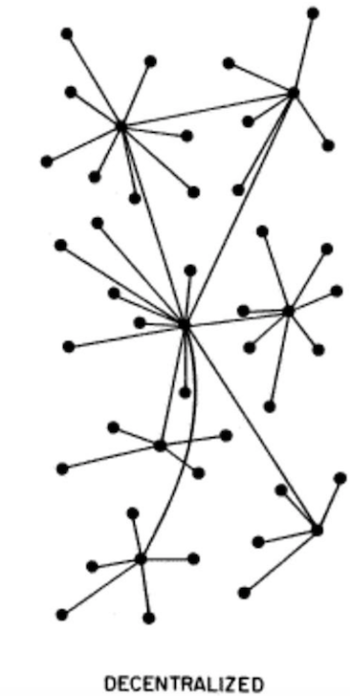
Decentralized – these types of networks are made up of more than one node unlike centralized networks. They are not run by authority, for each separate node acts as its own, however are all existing within the same space. 

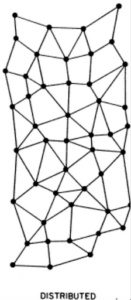
Distributed –  these networks are the type. They are made up of multiple nodes like Decentralized, however what differs here is the way they interact. “Applications in which computation is distributed across components, communicate and coordinate their actions by passing messages. The components interact with each other in order to achieve a common goal.”
CYBERSPACE

Cyberspace is explained to be a graphic representation of data – a consensual hallucination. (William Gibson,1984). The idea of cyberspace is that it is the home of the mind, an existence within that of ourselves, but also an external factor. Think of this as the vast world of the internet and the way it exists within thought or, a hallucination if you will. “Cyberspace consists of transactions, relationships, and thought itself, arrayed like a standing wave in the web of our communications. Ours is a world that is both everywhere and nowhere, but it is not where bodies live.” 

LIQUID LIFE?

Now that I have briefly discussed the idea of the network society paradigm, its networks and the identity of cyberspace in relation to the vast existence of the internet, I will be introducing Liquid Life. 

Going off how the telegraph changed communication, how the internet and mobile phones grew from the extensive technological advancements of time, it is only right to assume the way society as a whole changes. New ideas, new ways of communicating, creating and displaying yourself openly to the world through the web. 

I’m sure we can all think of plenty of changes to society based on these factors, however one that really stuck out to me is the ideas of Liquid Life, or Liquid Labour. Today, everyday life has become another way of working. Everything is about work, rather than about life-style. This has created the ideology of Liquid Life, which can also be referred to as Liquid Labour. 

This brings us to the New Capitalism. “The relationships of capital and labour, argues Manuel Castells, are increasingly individualized and organized around the network enterprise form of production, which integrates the work process globally through telecommunications, transportation and client-customer networks. Such worldwide integration introduces a fundamental aspect of unpredictability to the nature of work,” 

This is the age of working culture, of hustle culture, of being overworked and enjoying it. Or, rather, presenting yourself as if you enjoy it. “…Not only does never stop hustling – one never exists a kind of work rapture…In the new work culture, enduring or even merely liking one’s job is not enough. Workers should love what they do, and then promote that love on social media, thus fusing their identities to that of their employers.”

THE LOGIC OF FREE INFORMATION FLOWS DEMANDS LABOUR THAT IS UNRESTRAINED BY BOARDERS AND ALWAYS AVAILABLE FOR WORK.

All of this comes from, as explored through ‘Liquid Life, Convergence Culture, and Media work’, a lack of stability and security. We do not work for a career any more, not really, in contemporary times aligned with that of social media, and networking, we instead create for short term effects. What is going to get this result right now, for we do not know how long this opportunity will last. The new capitalism. This has become extremely prevalent in the way of working off social media platforms. Everything is based on current flows, trends and catching up. 

This idea of Liquid Life is not something majorly negative, though nor is it inherently positive. This type of ‘hustle culture’ has created mass amounts of opportunities for society. It’s this idea that “anyone can make it”, anyone can achieve big goals and aspirations. Especially from social media platforms like Instagram. Anyone can gain success, power and influence over networks. 

That being said, this type of work-style not life-style has enabled the lack of self-care. When everything becomes about work and not about life – about a healthy balance between the two – then you will often find yourself a victim of burn out, “a state of emotional, physical, and mental exhaustion…” This wave has moved forward the lack of care one has for themself, which is why the importance of self-care is so important within today’s society. For you will never be performing at your best when struggling in the overwhelming nature of hustle culture.

Liquid Life offers up both positives and negatives for the future in society, and like most things, it is incredibly important to structure a healthy balance between the two and to start living a style and work style. 

REFERENCES 

A declaration of the independence of Cyberspace (2016) Eff.org. Available at

A Global Nervous System [BCM206] (no date) Prezi.com. Available at

Ashby, J. (no date) 1.4 The network society, Soas.ac.uk. Available at

Centralized vs decentralized vs distributed (2019) Blockchainengineer.com. Available at

Civilization of the mind: understanding the network society paradigm (no date) Prezi.com. Available at

Griffith, E. (2019) “Why are young people pretending to love work?,” The New York times, 26 January. Available at

Mark Deuze (Indiana University) (2006) “Liquid Life, Convergence Culture, and Media Work.” Available at

Melinda (no date) “Burnout prevention and treatment – HelpGuide.Org.” Available at 
Hey, Hey Community Round Two – Peer Review

Last week I shared the pitch for my Digital Artifact, where I breakdown my intent and personal media niche for the semester. You can read the post here, but as a quick overview I plan to conduct research into the media niche of music – specifically around the pop punk, emo metal genres – by observing the communities and personas built around them online. Last week, it was not only me but my peers who shared these types of blog posts and I have had the privilege to engage and peer review some.

“The process provides a reviewer with the opportunity to reflect on someone else’s work and to provide thoughtful comment using his/her own knowledge and expertise of the subject.” Peer reviewing is an important aspect in not only gaining insight into your own abilities but it allows the chance to be interactive and supportive to others. I think this is a great aspect of the community we have. I believe that I was able to convey my feedback and critique well by engaging my personal understandings with each pitch and providing ideas the authors might not have thought of. It is important to me to not just focus on anything negative, and to be helpful in furthering each project as well as highlighting a job well done.

Hannah’s Digital Artifact pitch goes into extreme depth about the ethnographic research about their chosen niche around the alarming forefronts of climate change. It is very well researched and clearly written which enables a multitude of audiences and understanding. Their post was detailed, structured and very professional when discussing this topic, as well as being incredibly informative. Because of this, when reviewing their post I included a secondary source – Bushfires in Australia: a serious health emergency under climate change – which explores their niche in relation to Australia specifically and could be useful in furthering their research and provides a geographical example of this crisis.

Hannah’s pitch was analytical and professional presenting, which is something I myself have taken away from this experience as something I need to improve. Their work was defined and developed to the point it felt personal and not a “University task” which I believe is something I can work on and develop in the future.

Lisa’s pitch was lovely and really taps into the whole concept of persona in relation to our lectures and class work. This, I believe, was expressed very much through her words as well as her audio visual elemented. It is clear to me that they have a tight understanding of who they present themself as in relation to Youtube, as well as their own media consumption. They were able to analyse the analytical concepts presented with clearity. Their pitch was broad and open, as one’s persona might be, and I provide a source in relation to mentioned ideas – cooking and healthy food – to perhaps aid in narrowing down some future points for their project.

Lisa’s work allowed me to see areas of persona, which is a very large aspect of my own Digital Artifact, that I myself am lacking in showcasing through my blog posts. For example, Lisa dives deep into the analytics of persona where I have just briefly touched on it to further my points not educate and engage. I believe this is something I can take away from by reviewing their pitch, along with making better and larger connections to frameworks and lectures as a whole.

Vincenzo does a great job at utilising both audio visual elements and blog post as a cohesive piece to be understood together, rather than simply having a blog post with a side of more information in a Youtube video. They are very interested in their chosen niche on a deep personal level that they have a personal connection. I think providing us with this information is great because it explores the relation between niche topic and creator – I would take the word or perspective from someone with pre-existing knowledge and persona before someone who is just touching the surface of a new niche. That being said, there was little explanation on why this is an interest, or why the photography element corresponds and going from that I provided a source which I hope aids in capturing how to express this in future.

Vincenzo’s Digital Artifact as mentioned before does this fantastic job at making both types of format cohesive, and I will be the first one to admit that this is something I struggle with in presenting. Engaging with their work has enabled me to witness examples and ideas on video creation which I can transcribe into my own work in the future. Their pitch was very helpful in this for me, and I appreciate the opportunity to review their work.

I think in the future I can improve the feedback I give by going further into the sources and even by providing more than one to enhance the take away for my peers. Overall though, I believe that by conducting peer reviews has not only given me insight into others but has allowed for me to grow in my own work and understanding. I will be taking everything I have learnt here and the critics given to me to grow with my DA.

“Help Me Find Something More” – So What’s My Niche

Recently, in some classes of mine at University, I have been directed to research and explore a media niche. Preferably something that we have an interested in as we’ll be continuously curating content within that realm for the semester. But how does one go about this?

FINDING THE NICHE

The best place to start with this, as someone who has done this type of thing in previous classes and years, is to take a look at yourself. No, really, I mean that. What are you interested in? How do you spend your free time? The better Digital Artifect’s come from something you find yourself creating anyway – it feels like less work if you actually enjoy it.
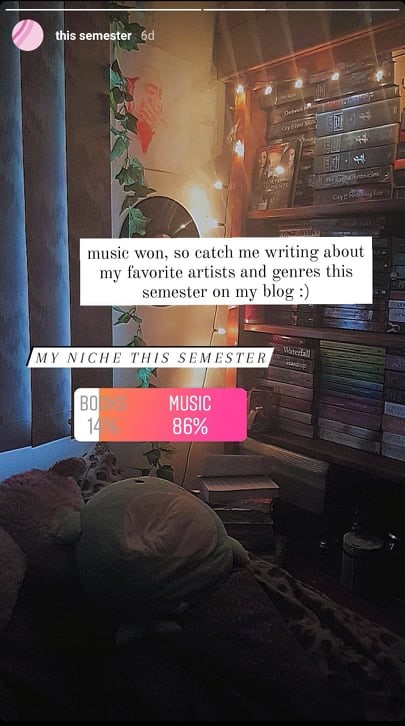
This led me to two things along with my pre-exisiting ideas. The first being books – I love to read and write all the time. The second was music – being what I like to refer to myself as a “retired scene kid”, music is a really fitting niche. I knew this semester I wanted to focus on my writing with this blog as I have been outside of University. I turned to my more content based Instagram and it’s exisiting audience to help with deciding which I should go with.

Ultimatly, music won by a long shot. I’m not mad at it at all.

SO MY NICHE

What’s great about this is how already engaged, even with previous Uni work, I am with my music taste and it’s subculutres. You might have heard the phrase that “punk isn’t just music it’s a life style”, which is true for most aspects of “alternative” (I hate that word, but don’t worry I’ll be explaining why with my later research) music culutre.

See I already create content around this niche, as well as enage with a lot of it. You should see my Tik Tok for you page, it’s truly the for YOU page. It really is a no-brainer to have music – specificly my own subculutre base taste – as my niche. I go into this aspect of my life a little bit in my “get to know me” blog post I posted recently. I even share good old 13 year old scene kid taylor photos.

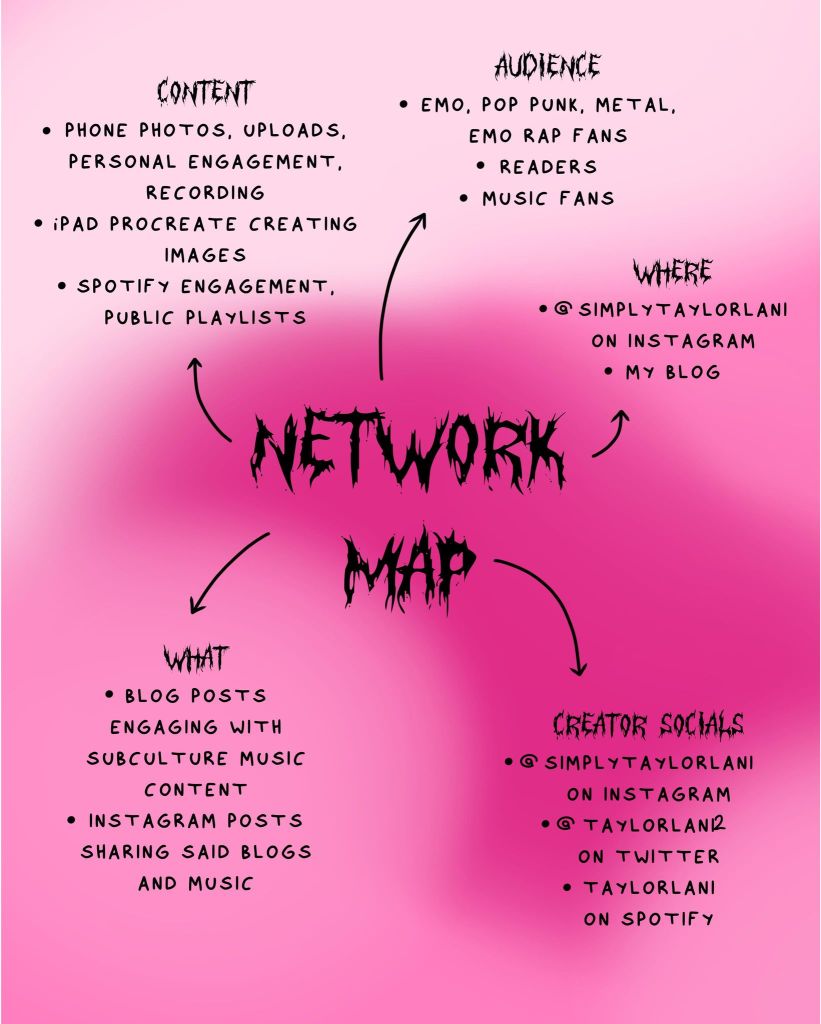
MAPING

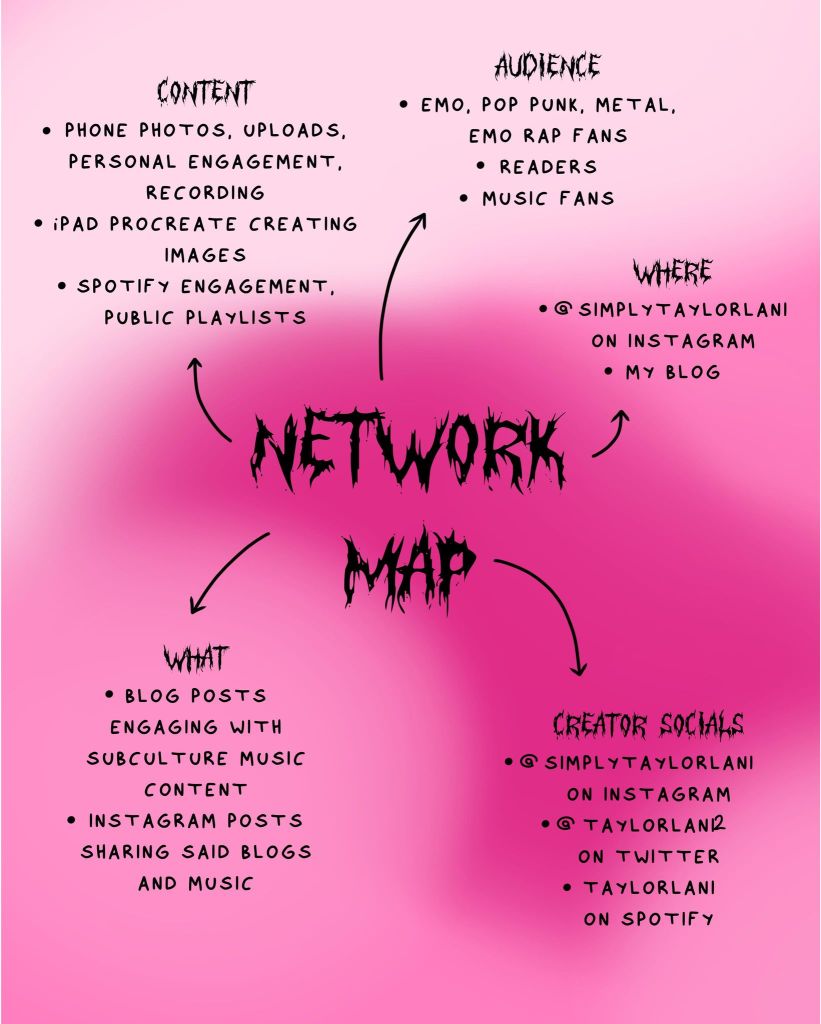
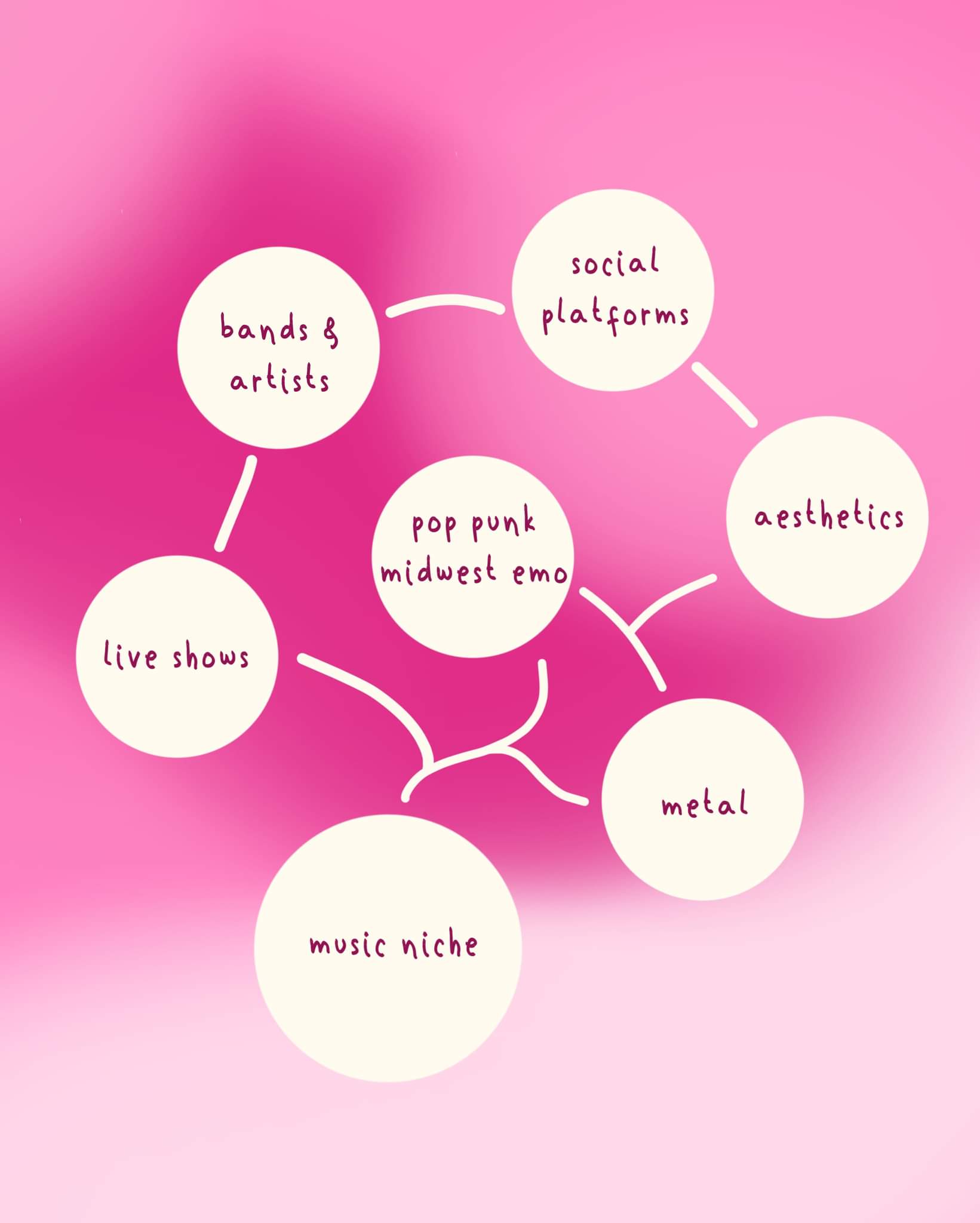
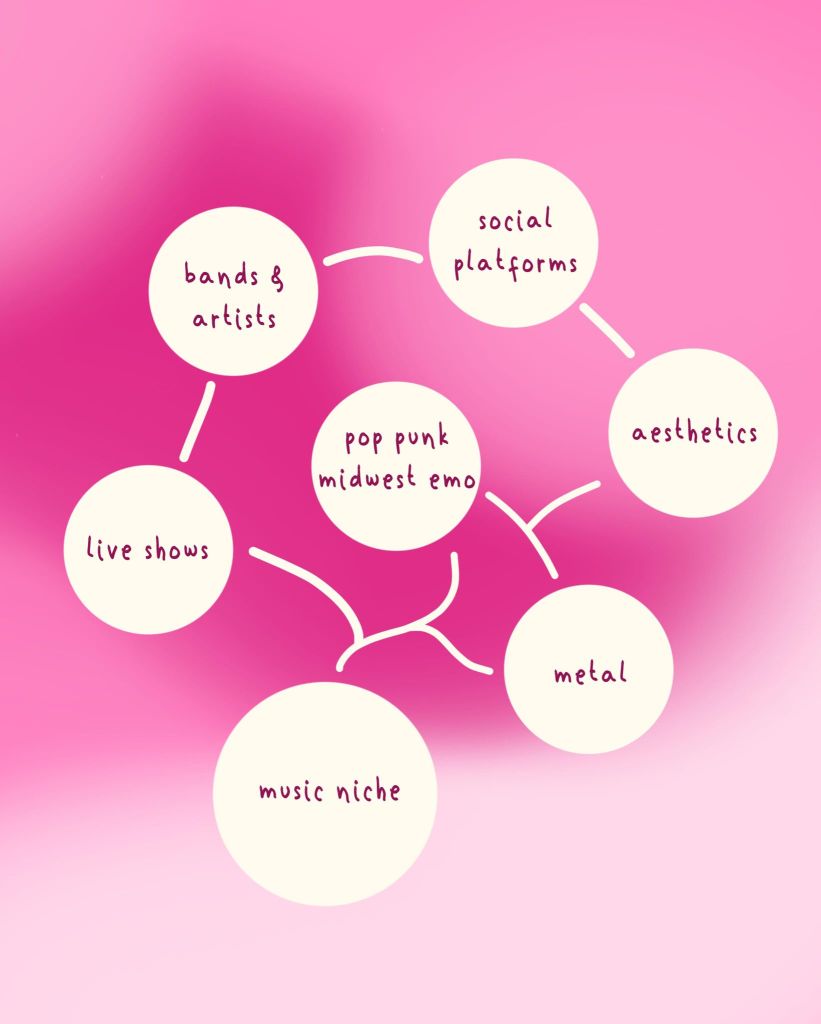
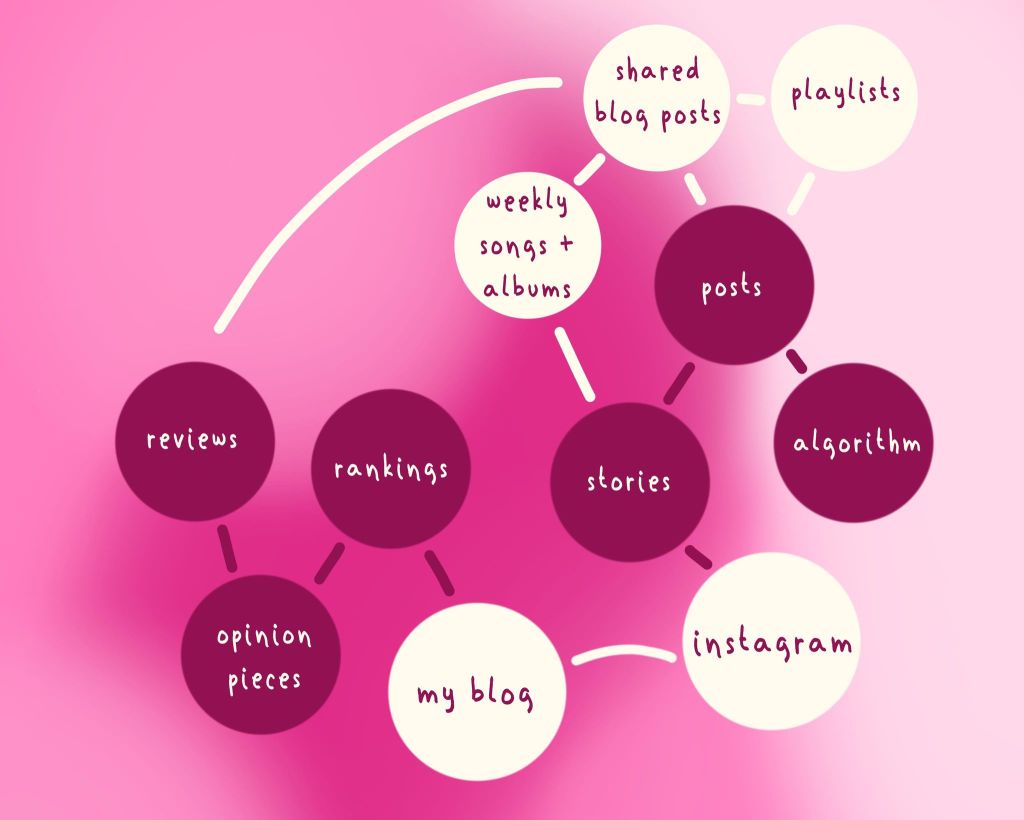
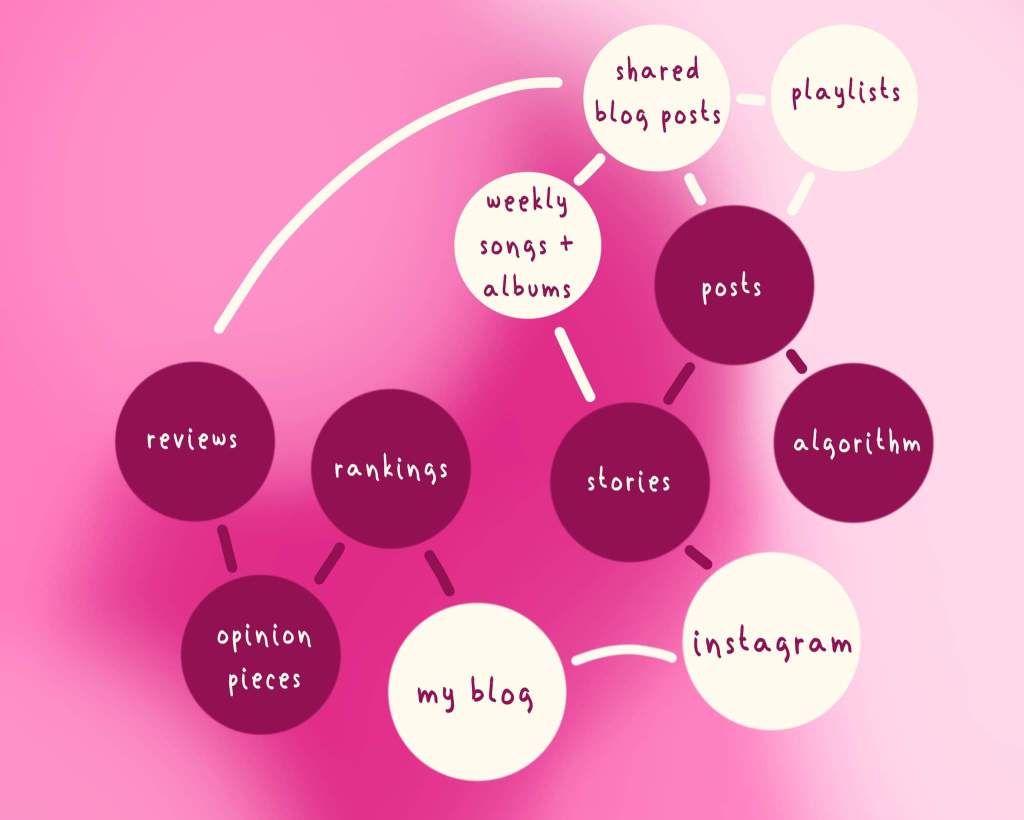
The way I wish to Network Map my niche can be broken down like this:

created on procreate by me

NICHE AND MY ONLINE PERSONA

Really anything you do online creates your public persona, think of the people you follow online and the way they present themself to you as a viewer. It really shows the way you engage with whatever your chosen niche is outside of the work you submit. Now, when your lucky like I am here, your niche will already exist within your persona.

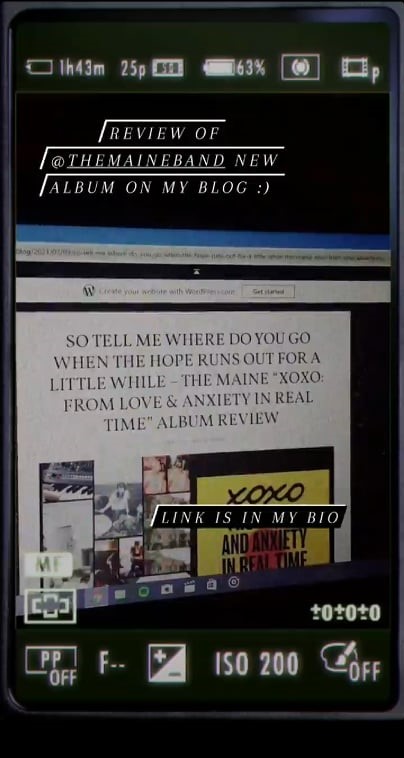
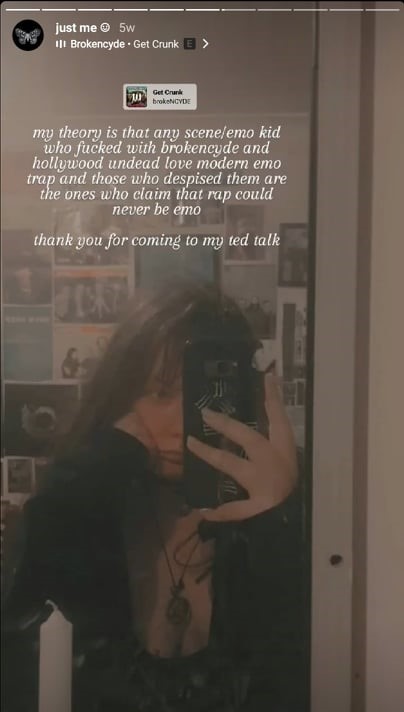
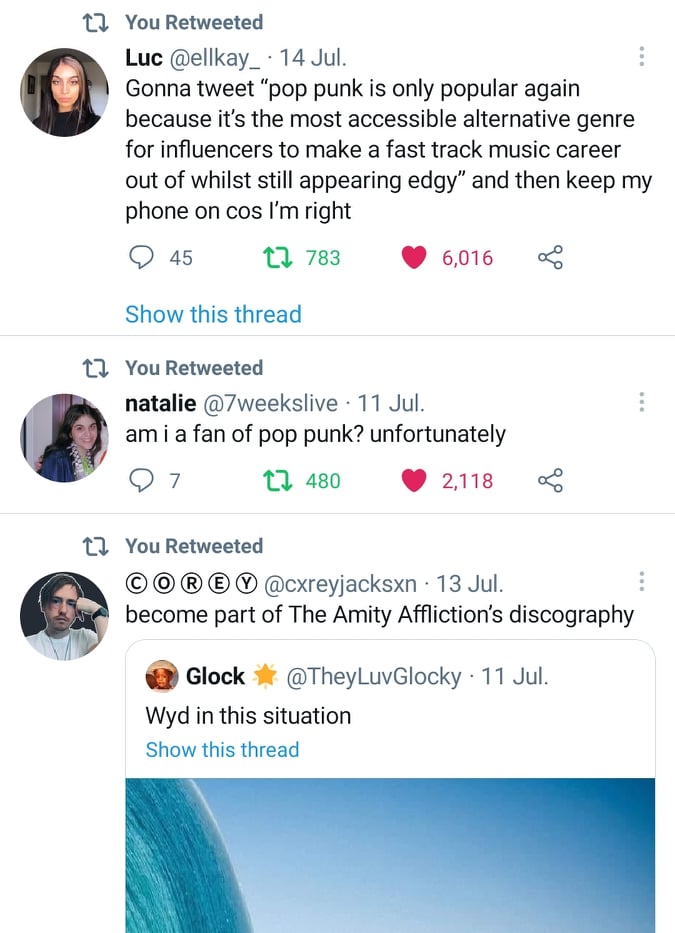
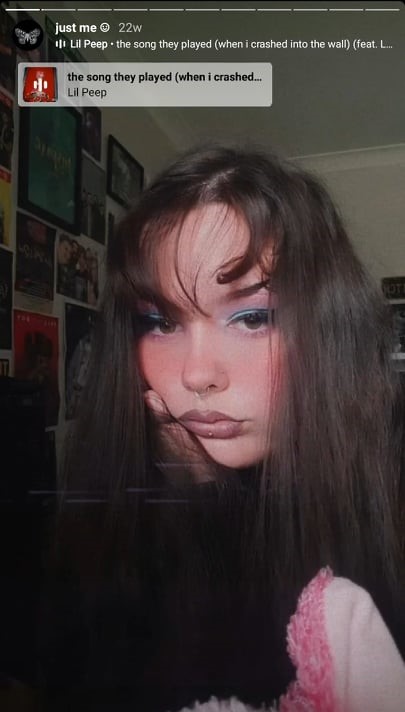
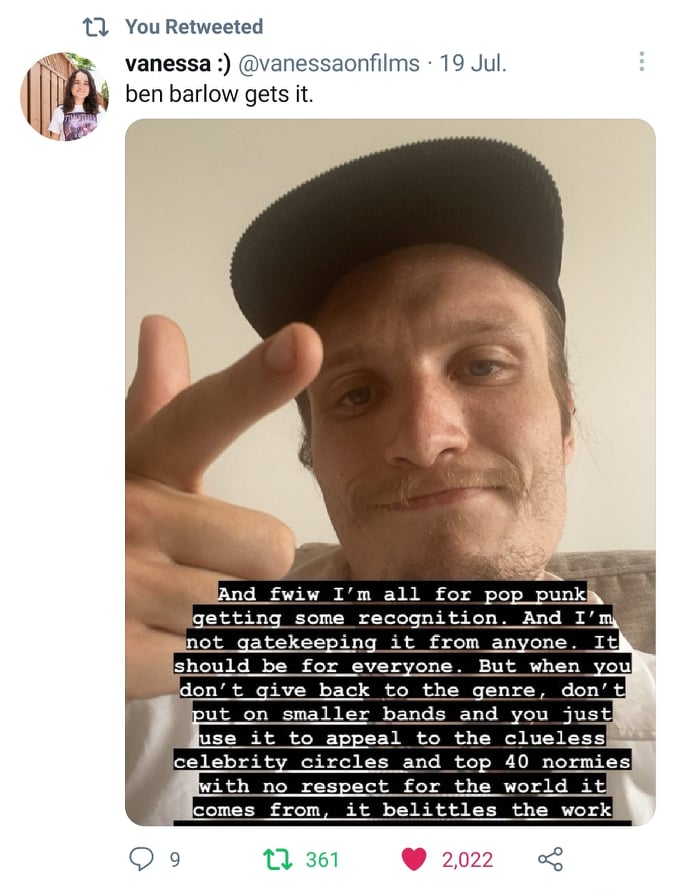
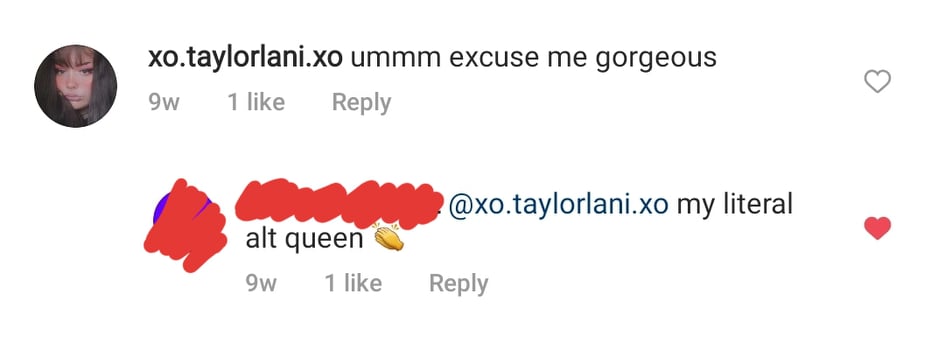
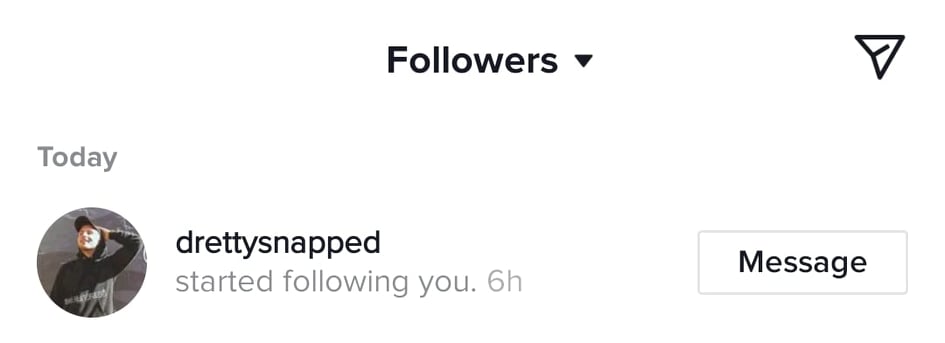
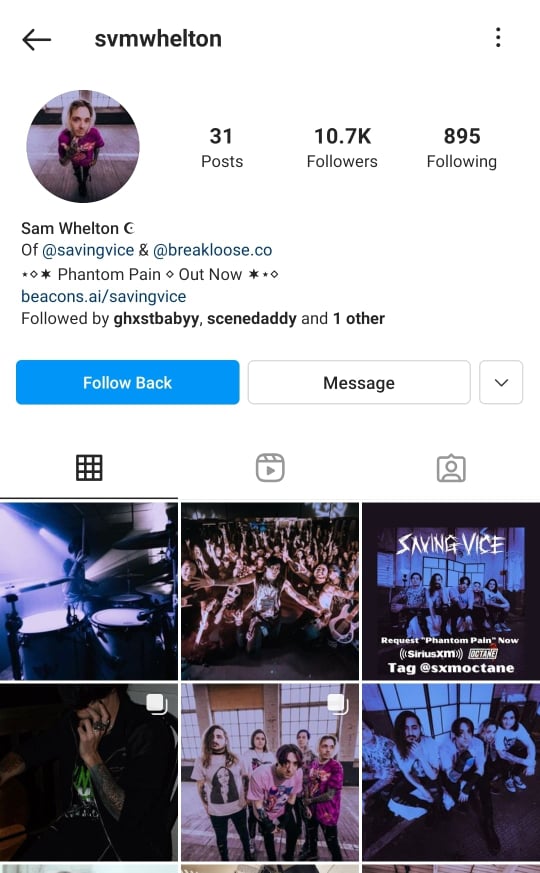
I have here a few moments from my social media where I have shared content related to this niche. It really is something I’m constantly around and creating for. So much so that I’ve made friends in many different ways and areas of this niche. Really, I’m still always so shocked when music artists follow me back, or follow me first even.

To be honest, music has been apart of my persona online for as long as I’ve had social media, so again, it really is just a no-brainer. I love writing or talking about it. I listen to podcasts around the “alternative” scene in my free time too. This just makes me so much more excited to delve further into this niche and create more content around it. I’m really looking foward to this semester. 🙂

REFERENCES:

Title Lyric, “Help Me Find Something More” – artist -The Stroy So Far, song – Upside Down.

Pixel Chix The Fever Dream?

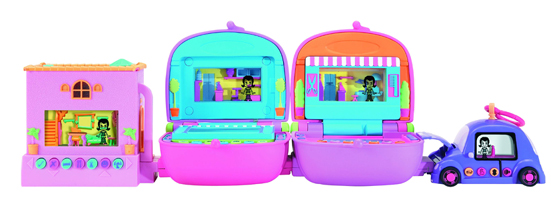
In September of 2005 a series of interactive toy’s begun under the name Pixel Chix. These games were interactive with an LCD screen and came in many forms over the years. Marketed towards young girls by introducing them to life through little pixel girl pals. Created by Mattel, these games were desgined for you to live within a house with your character. You were able to dress them up, feed them, have pets and put them to bed. Over time the toys begun to add more to how you could play with different generations.

When thinking back on these games, which ultimatly ended as physical devices in 2009, we are met with intense nostalgia – an analytical framework which these games can be viewed through. I wasn’t sure if Pixel Chix would be an incredibly niche “old” game, especially considering how little it is brought up in spaces when discussing childhood games. However, after looking through the responces of this tweet of mine I knew it wasn’t just me who felt that hard love for these games as kids.

Pixel Chix House created a loveable expierence in little kids. Not only were you able to dress up and play with your girl pal yourself, you were able to connect the houses together and vist each others homes anc charaters. This created a connect, in person expierence for kids in the 2000s to play together. There was orginally three styles, “Cottage”, “Loft”, and “Mansion.”

Over the years Mattel made many different generations of Pixel Chix.

Road Trippin Vehicle, 2005

2-Story House, 2006

Love 2 Shop Mall, 2006

Roomies, 2007

Babysitter, 2007

Unlockets Charm, 2007

Pixel Chix TV, 2008

Fab Life, 2008

Secret Life of Pets, 2007

McDonalds Happy Meal Toys, 2008

https://mattel.fandom.com/wiki/Pixel_Chix

Pixel Chix was also hosted as a game under “EverythingGirl.com” which lasted several years past the production of them in 2009, until the site closure in 2014. This makes me question the way I would analyse this game. As stated before, when talking about nostglic games Pixel Chix is non exisitant in many spaces as an option. Yet, when directly asked many of us as kids loved them so much. Until doing research I had no idea that the there even was a website game.

Unlike many different childhood games like “Temagotchi,” and “Cooking Mama”, Pixel Chix has not made any kind of new wave technoglical developments, there has been no new console game or phone app. It’s like it never really made that big of an impact, or if it did consdering they even had a McDonalds toy line, that it was not long lasting at all. Maybe this has to do with the games being developed by Mattel the toy line which is always mass prodcuing new content.

Pixel Chix might not be something that instantly comes to mind for anyone, yet it still has managed to fit in the gaps between the ones you do think of straight away. I think that has to say something, it’s not hated as i saw in the replies to my tweet, but its not remembered even though it was well liked. It’s a game that really sticks out as a fever dream to many people – which in a way is quite a unique type of nostaglia.

Hey, Hey Community – A Peer Review

Hey, hey!

Last week I shared a blog post dedicated to pitching my Digital Artifact idea for this semester at University and so did many of my peers. You can read it here, but as a quick reminder, I will be conducting investigative research into music and sounds of video games and analysing their importance along with their effects. After this though, I was given the opportunity to read and give feedback on fellow students’ pitches. I think it is such a rewarding thing to have a community to give and receive feedback from, and I took this process to really reflect on even my own critiques in order to advance forward with my work. I hope those who I had the honour of reviewing feel that from the feedback I shared.

Firstly I reviewed James Mckay’s pitch, and while this might be my longest comment I am so incredibly excited to see where James goes with their ideas. Their pitch presented the question of “Do Video Games Suck?”, and goes on to explore the relationship of different era games – the old vs. the new – to analyse the quality of them. They intend to do this by streaming on Twitch and having a rank type system of three similar styled games.

I love this idea, and I made sure to relay that in my feedback. I’m a very opinionated person and am attached to certain games based on my own experiences. This really stuck out to me because I really allowed myself to see how little my own pitch goes into when it comes to audiences or even the type I wish to attract. It is clear to me, based on the game like examples in my own pitch, I could have conducted more research into the who these target audiences are and why certain scores/soundtracks are presented to them.

I then moved onto reading and engaging with Jules’ pitch, which really struck me because of the similar concepts but different ideas involved. I love seeing how differently people can execute projects. Their DA dives into the concept of nostalgia and its correspondence in gaming. Not only that, but they included the science side of things, going deep into what they wished to achieve with this project.

I feel like I might be excited for everyone’s DA’s, and Jules’ pitch really cleared me up on how I should handle things in my own work. Her audio/visual was very clean and still simple and as someone who really kind of struggles with that it allowed me to see ways that I can improve.

Lastly, I took a look at Jacob’s pitch blog post, and it was instantly recognisable. Their project was detailed and very clear to read, explaining how they intend to utilise their youtube channel to make game commentary around FIFA and further explore and analyse it from there. I found that Jacob’s pitch was very researched and had clear drawbacks to class content and lectures.

I really liked this about their pitch, because it is very clear on my own that I need to improve my engagement with frameworks and lecture understandings. Which is something I know myself as well as feedback given to me over the course of peer reviewing.

Throughout this process I was able to gain insight and understanding of other people’s projects which enabled me to take a look back at my own, critique it and has given me the ability to better my personal Digital Artifact in the long run.

Oh, God, The Sims Mobile

I’m sure most of us to some extent are aware of The Sims game or have even played most of them. Seperate from SimsCity, The Sims series started all the way back in 2000 with the release of what is refered to as The Sims 1. Now, it’s not too far fetched to say that this franchise is one of the most successfull for games. I can think at the top of my head a handful of different Sims games. For example, Sims Castaways, Sims Medievial, Sims Pets etc.

However, I’m not here to discuss the successes of The Sims. No, Im here to go over one of the biggest fails instead.

The Sims Mobile.

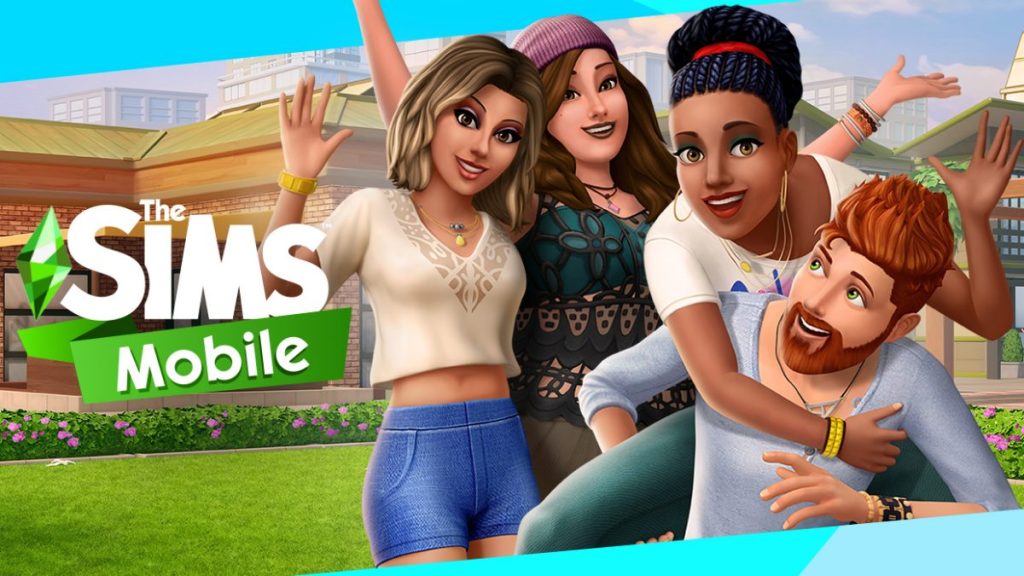
Now, essenitally, The Sims Mobile is just a phone version of The Sims, or at least it wanted to be. Released in March 2018, “players are able to create unique Sims with the in-game character creator (Create-a-Sim), build houses, start families and control the lives of their Sims.” In theory that should be a great thing and that this should be a great game.

Instead, it was met with mass disapointment and bad reviews. Not only that, I don’t think I’ve ever heard anyone bring up this game ever.

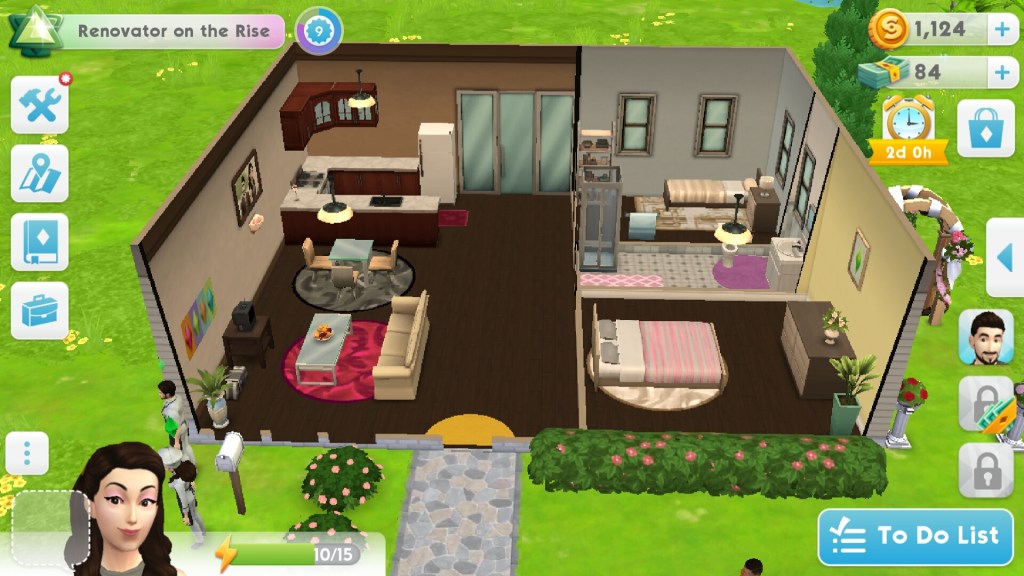
Most people have issues with the gameplay. For example, they found it boring and as if you were simply pressing buttons. Also, as a common cirique with EA Sims games, you have to pay to really enjoy it. There is a limit to four Sims that all live within the same house. The game doesn’t validate player’s time and investment either, for like a lot of mobile games, to do anything you use energy but unlike in the PC games you can’t just feed or put your Sim to bed. Instead, you have to wait – and wait – until you can even play again.

All of these things and defiently more left Sims fans bored and uniterested. I lot going to say they uninstalled it the next day. In fact, if I remember back to 2018, I did the same thing and I only installed it to see how bad the game was myself.

One notibale comment is that it is a phone game and that it shouldn’t have the same expectations as PC. While this is true, this also is quite simply the solution to the game’s downfall. In theory, if The Sims Mobile was created not nessiarily like a cash grab and was produced to emulate The Sims 4 in accuracy, gameplay and grapfically, then possibly this could have been avoided. If, purhaps, there was more care to creating a good game, however that is another comment EA recieves all the time.

As I was saying before, so many diffferent Sims games come to mind when you think of them. Arguably most people could list a few at the top of their mind. Yet, The Sims Mobile flopped so badly that no one ever really considers its existance. And if that doesn’t show how failed your game was then I don’t know what does.

REFERENCES

Beausoleil, M. (2021, March 13). Ten ways EA is ruining their Sims empire. Retrieved August 17, 2021, from Medium website: https://beausoleil.medium.com/ten-ways-ea-is-ruining-their-sims-empire-b67c95c587df

Guest Writer. (2018, July 3). 3 reasons why Sims mobile misses the Mark: In-depth analysis — deconstructor of fun. Retrieved August 17, 2021, from Deconstructoroffun.com website: https://www.deconstructoroffun.com/blog/2018/7/2/simz

The Sims Mobile. (n.d.-a). Retrieved August 17, 2021, from Fandom.com website: https://sims.fandom.com/wiki/The_Sims_Mobile

The Sims Mobile. (n.d.-b). Retrieved August 17, 2021, from Miraheze.org website: https://crappygames.miraheze.org/wiki/The_Sims_Mobile

Timeline of The Sims games. (n.d.). Retrieved August 17, 2021, from Fandom.com website: https://sims.fandom.com/wiki/Timeline_of_The_Sims_games

(2019). My first time on the Sims mobile: A worse Sims 4.

Video Game Music Pitch

Hey, hey!

After looking at nostalgic, old games and ones that have failed in previous weeks, I have decided for my Digital Artifact I will be discussing and looking at the music for games.

EXAMPLES AND RESEARCH

Examples of popular video game music that comes to mind almost instantly is the die hard love for Nintendo’s game scores. Often uploaded and shared via social platforms like Youtube in “relaxing”, “study” playlists with thousands of views.

And it’s not just claming Nintendo scores that are popular, even though they come to mind so quickly.

Simon Wood’s “Video Game Music, High Scores: Making Sense of Music and Video Games” – goes into the connection between games and popular culture and how “the video game has now become a ubiquitous part of the domestic landscape.” Along with how fastly growing in importance it seems to be. “In the United States, the National Academy of Recording Arts and Science now includes music from video games in the ‘Score: Soundtrack Album For a Motion Picture, Television or other Visual Media’ category in its annual Grammy Awards.”

THE DA

For this Digital Artifact, dissecting music by understanding the formal elements of games. Formal elements include the basic rules of the game (you know, setting, theme, narrative and genre.) However, it also includes things such as features, controls, software/hardware requirements, difficulty settings, its goals/challenges, as well as its sound design.

I will be writing about and analysing popular soundtracks, scores and sounds from video games to uncover the reasoning for this. I will be conducting textual analysis of games, exploring the love and hype around their musical attributes, and questioning why that is. For example, what makes this soundtrack stand out? How does it make you feel? I will be using this blog to publish posts doing as such, along with my content based Instagram, Simply Taylorlani, where I will be sharing more casual content about game music.

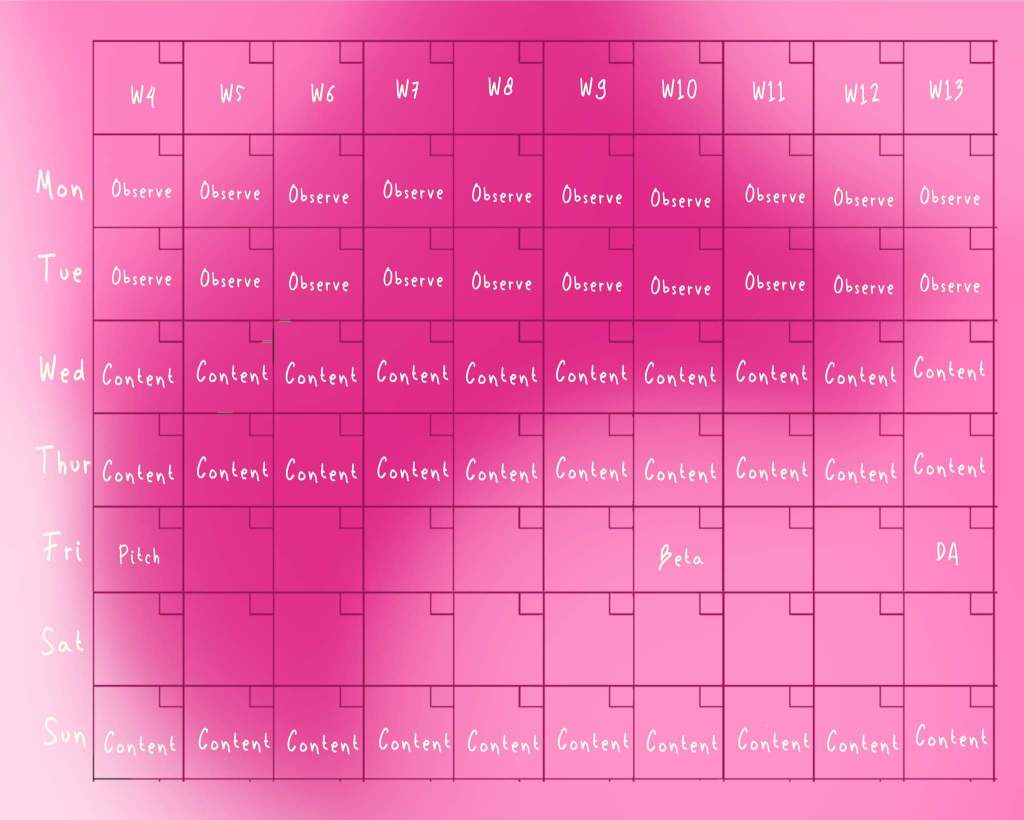
Here is a visual display of my outlined plan for this Digital Artifact for the course of the semester.

OVERALL

In whole, this Digital Artifact has the aim of providing a deeper analysis and understanding of game music for not only myself but my audience. I hope to gain insight and knowledge into the way game music production is created, its importance and why we as players hold such love and connection to scores.

REFERENCES

(2020). dream land || nintendo ost + thunderstorm ambience.

(2021). Little Nightmares 2 – Ambient Soundtrack Mix (Depth Of Field Mix).

KeithByrne. (n.d.). Retrieved August 20, 2021, from Deviantart.com website: https://www.deviantart.com/keithbyrne

Wood, S. (2009). Video Game Music: High Scores: Making Sense of Music and Video Games. In G. Harper, R. Doughty & J. Eisentraut (Eds.). Sound and Music in Film and Visual Media: A Critical Overview (pp. 129–148). London: Bloomsbury Academic. Retrieved August 20, 2021, from http://dx.doi.org/10.5040/9781628928969.ch-007

Simply Taylorlani Goes Musical, Another Pitch

Previously, I have mentioned how for this semester how Simply Taylorlani will be taking a musical approach to the Digital Artifact. I have been able to map this out and narrow down these ideas further as you can see down below. Music as a whole is a very large and broadly open niche and because of that I have simplified it down to two prominent subcultures. 

THIS DA

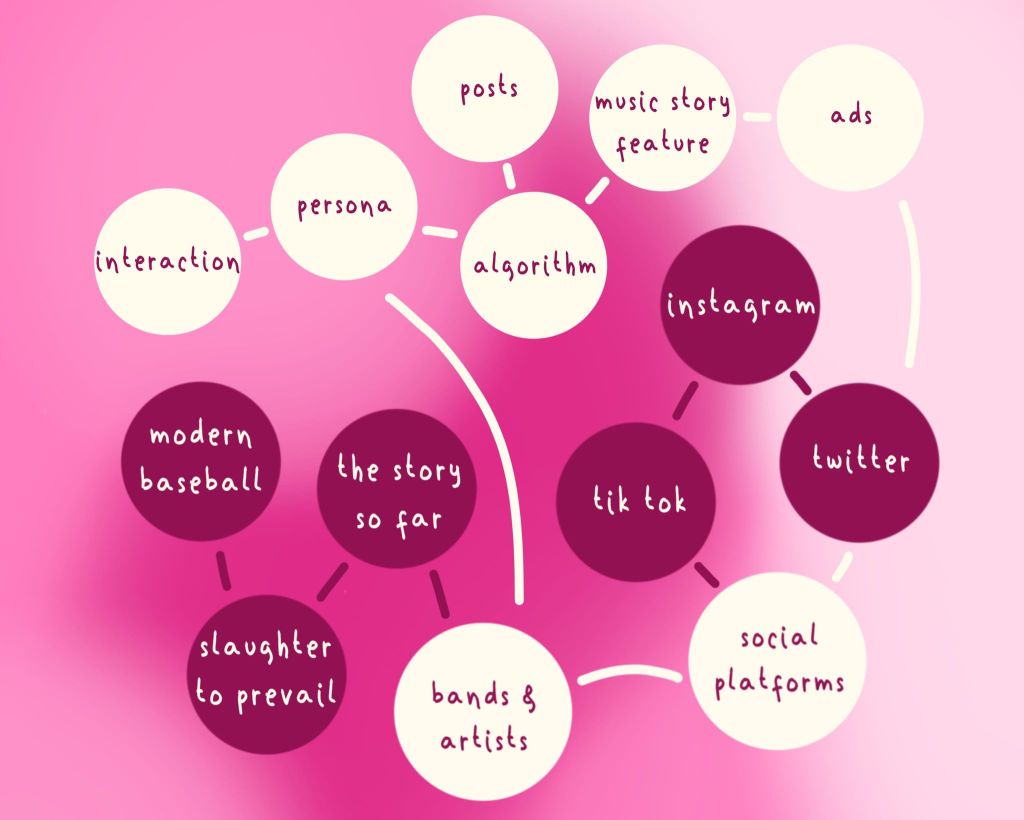
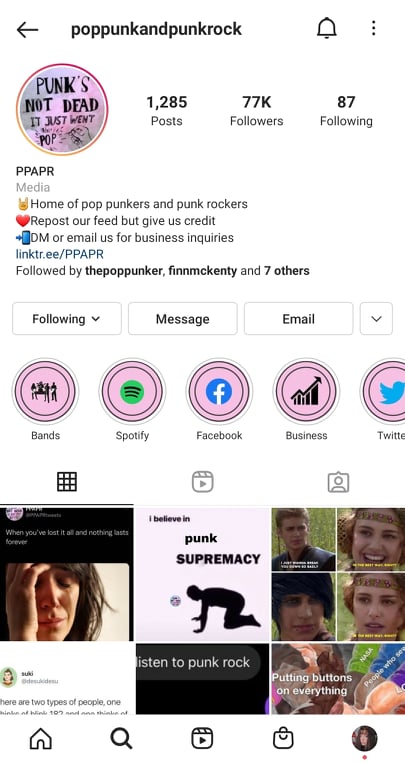
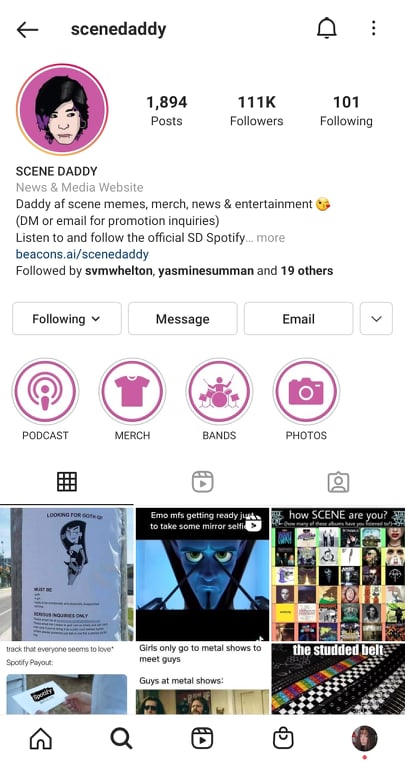
For this project I am planning on observing and writing about music that is a part of both the pop punk/emo and metal subcultures, genre and communities that exist online. For example, social platforms such as Tik Tok and Instagram along with their algorithms create very large communities of people with similar interests. This then leads to content creation and, for platforms like Tik Tok where audio and music is such a major aspect of the app, aids in the culture, aesthetics and persona attached to music.

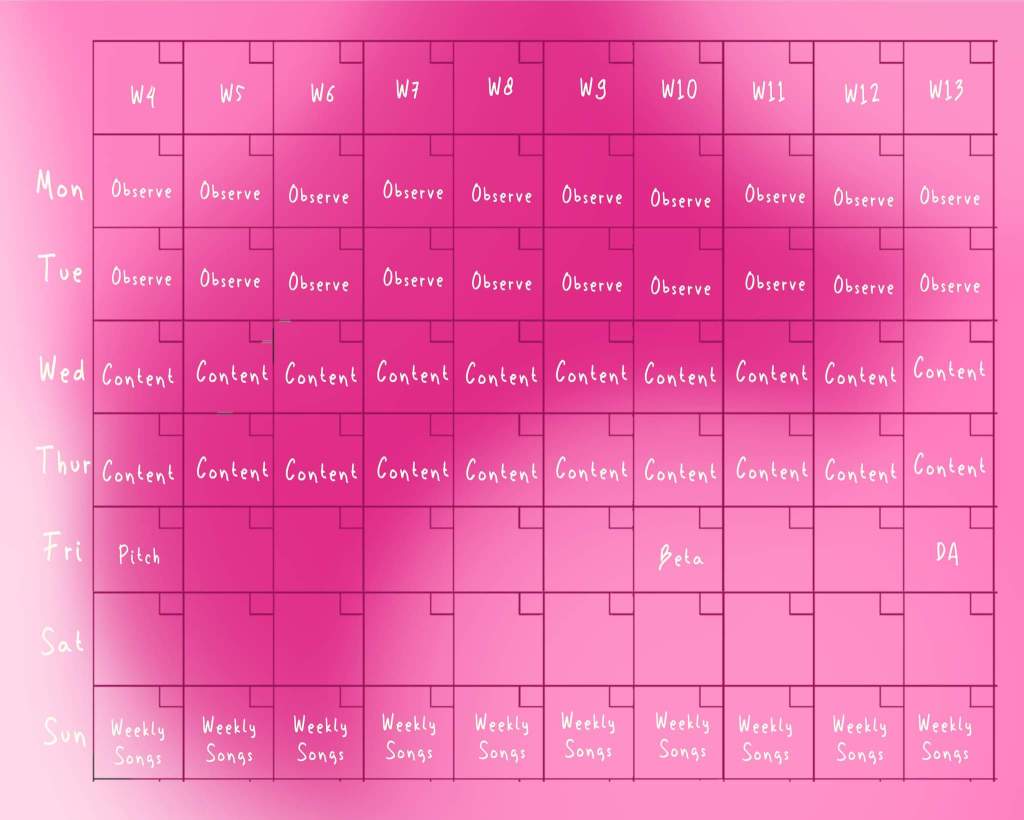
I will be creating content based on these music genres and their personal cultures that are tied and produced along with the music. I will be using my content based Instagram, Simply Taylorlani, along with this Blog, as a means to share and engage with these ideas. The plan is to produce writing content such as reviews, rankings, and opinion pieces around these subcultures. I also intend to be active on Instagram to share my favourites from things from these communities and already have some highlights dedicated to this Digital Artifact.

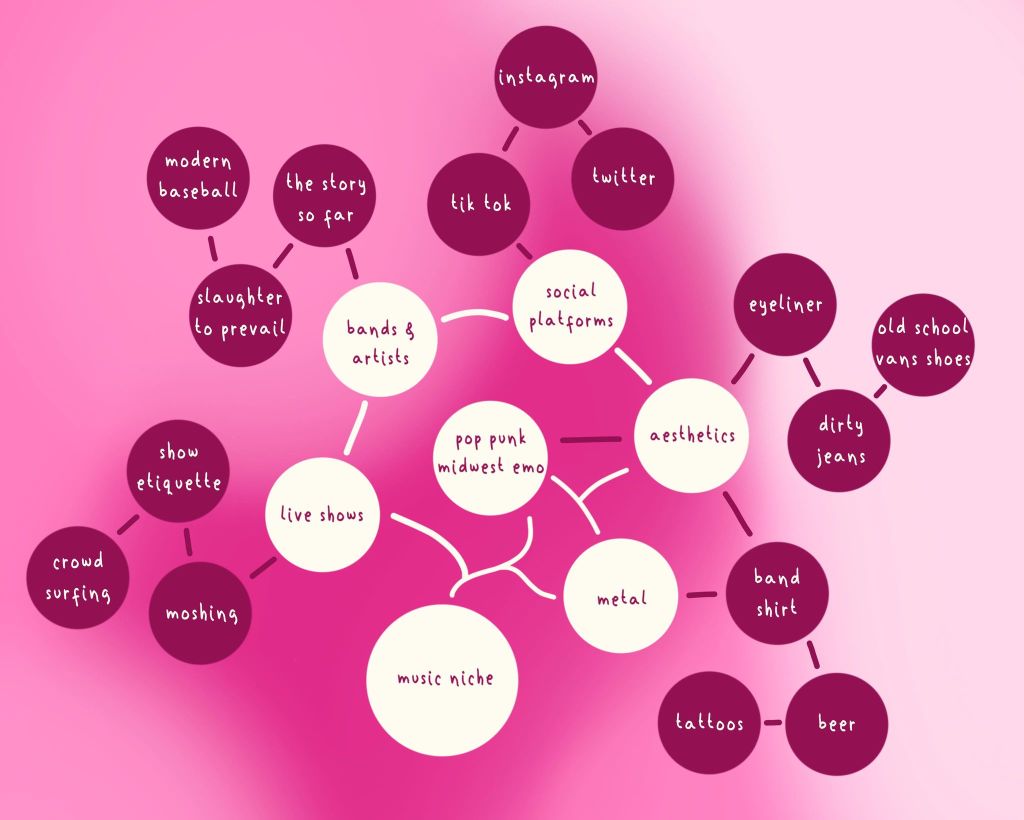
Map for the Da

CONTENT EXAMPLES

Along with this, I have also previously mapped out the different aspects and networks to my Digital Artifact which I have shown before but will share again here.

chart / calendar

POTENTIAL QUESTIONS

I am interested in this DA because of my own personal connections to both these subcultures and genres. However, I do think that enables me to have a leg up in understanding as I already have a pre-existing persona tied to this niche. But, that of course does not mean I do not have research questions.

What makes a good album?

What seperates a band/artist from the genre as a whole?

What determines the best album?

Why are aestheitcs so important?

With this DA comes risks of being unethical, especially when considering how important someone’s identity and person is to a person, even one that is heavily connected to this genre of music. Even those who create the music, they put a lot of themselves out there into artistry and this DA in no way will be used to discredit or tear down bands, artists, producers, audiences and communities. This Digital Artifact is about music and culture. 

“Practice Your Passion On Me” – Feild Site’s, Huh

Hey, hey!

My last post was on my niche for my Digital Arteifect for this semester at University and this week I’ll be discussing the feild site which coresponds to that. For a little reminder for what my ethnographic research, I have chosen to work within the niche of music, more specificly music that falls within certain subcultures I listen to.

WHAT IS A FEILD SITE?

A feild site is a great way to map out and understand a niche to refine it further and explore different angles. A feild site is the spacial characteristics between a type of research. Think of it as a web of relations between research, and how they all connect back to one thing. “For ethnographers, defining this space is an important activity that traditionally takes place before and in the early stages of fieldwork.”

MY FEILD SITE

I started with really narrowing down which subculutre’s I’m most interested in researching for this Digital Artifect and came up with mainly metal and the pop punk/midwest emo areas because those are the specific niches I’ve eneged with the most. Not only that, both of those have culutre that is completely seperate but goes in hand with the music.

I will be conducting enthnographic research from engaging with my niche from these key areas: Social Platforms, Live Music, Aestheitcs and Band/Artist themselves and while I’m going to be looking at them seperately, there is of course overlap.

SOCIAL PLATFORMS

Platforms like Instagram and, for a good example of a social platfrom with the music niche, Tik Tok, an app where audio is so largely important. Not only that, but Tik Tok like most other platforms has a very personal curated algorithm and tags. An important part of this to note is how Tik Tok is often refered to as the new Tumblr, where a lot of the pop punk/midwest subculutre bread and grew from in the last decade. This can easily be connected to Aestheitcs.

LIVE MUSIC

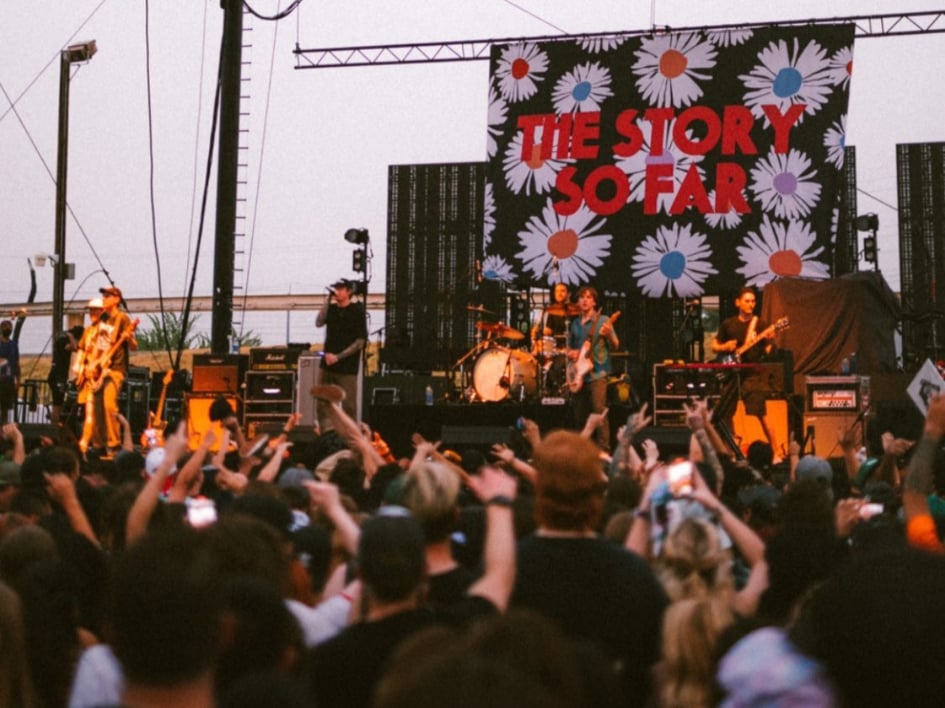
Just as important as social media, Live Music exists within the same niche and web, however has it’s own culture and corespondants. For example, concert ediquite which very much depends on the type of music you’re listening too. Within Metal and other heavier genres it is increadibly common knowlegde how agressive the shows can be compared to others. The likelyhood of seeing an agressice death wall at a Rex Orange Country show to Slaughter To Preveil one is vastly different.

AESTHEITCS

People who enage with these types of subculutres are very much tied to the phrase “It’s a life style,” and for most it really is. Just going off pop punk and emo we can tie down how important the aesthetics are to the community. This is why Aesthetics link back to Social Platforms which are all about persona and imagery.

BANDS AND ARTISTS

Of course to really conduct ethnographic research for music you need to look at who creates the subject in the first place. They are probably the largest connecting factor, they are the curators of content that has allowed for the rest of the webs to branch off. Each one, even within the same genre, are making content for different audiences, different aesthetics – for example Ice Nine Kills is a whole brand relating to horror movies which is very unquie to them.

Simply Taylorlani The Musical Edition Pitch

Hey, hey.

If you remember my last Digital Artifact which was entirely art based, then I guess you might be surprised that this one is mostly not. Over the course of time my old Digital Artifact died and was reborn into Simply Taylorlani and this semester I’m focusing on my writing which just so happens to be on this blog.

Essentially my DA has the aim to produce more writing content and after taking a moment with my existing audience on Instagram, we narrowed that down to music. Which is great, I love writing about music whether it’s reviews, my opinions, ranking artist albums and breaking them down. This is something I do in my seperate time already.

I love engaging with artist content in a constructive way, especially when someone releases a new album or single. Personally, I found I know a lot of people that don’t really think of things that way when they listen to music. They just say if they like it or not without really going deeper. I want to go deeper with this. I enjoy going further into music than the surface.  

I also showcase a lot of this on my content based Instagram which goes in hand with this DA. For example, I’ve started sharing a weekly song and album’s which I’ve enjoyed or have been on repeat for myself. Along with this I have some of my Spotify playlists public for my audience while over the course of this semester I create and update one with my weekly music choices. Maybe even others depending on how the semester goes.

I hope that with this Digital Artifact I can introduce some of my audience who don’t engage with my personal taste to different music or even get them to think about it differently.